
Baysian Networks for Kidney Failure
A chatbot that doesn’t guess, it reasons. Built on Bayesian Networks, it supports decision-making under uncertainty by updating beliefs step by step as new information is provided. The result is transparent, adaptive reasoning that users can understand and trust.

What This Project Is:
This project is a decision-support chatbot built on a Bayesian Network. Instead of generating answers based only on learned patterns, it performs structured probabilistic reasoning.
The system models relationships between variables and updates probabilities as new information is provided. Each user input refines the model’s belief state, producing responses that are evidence-based and explainable.
This architecture is designed for situations where data is incomplete, multiple factors interact, and decisions must be justified. The chatbot does not simply return an answer. It computes how likely outcomes change as evidence changes.
By combining a conversational interface with a causal probabilistic model, the system delivers transparent, uncertainty-aware decision support rather than black-box predictions. Our chatbot is built on a causal probabilistic structure.
This gives three major advantages:
- Interpretability
Every conclusion comes from explicit relationships and probability updates. The reasoning can be inspected, explained, and trusted. - Robustness to Uncertainty
Bayesian Networks are designed for missing or partial information. The chatbot still works even when the user does not know all the answers. - Human-Aligned Reasoning
The system reasons in a way that mirrors how humans think under uncertainty, updating beliefs rather than producing fixed outputs.
Example
A traditional chatbot might say:
“You have a high risk.”
Our system updates probabilities step by step and can explain:
“Given factors A, B, and C, the probability increases from 20% to 45%. If factor B were absent, the probability would drop to 28%.”
The difference is not just the answer. It is the reasoning behind it.
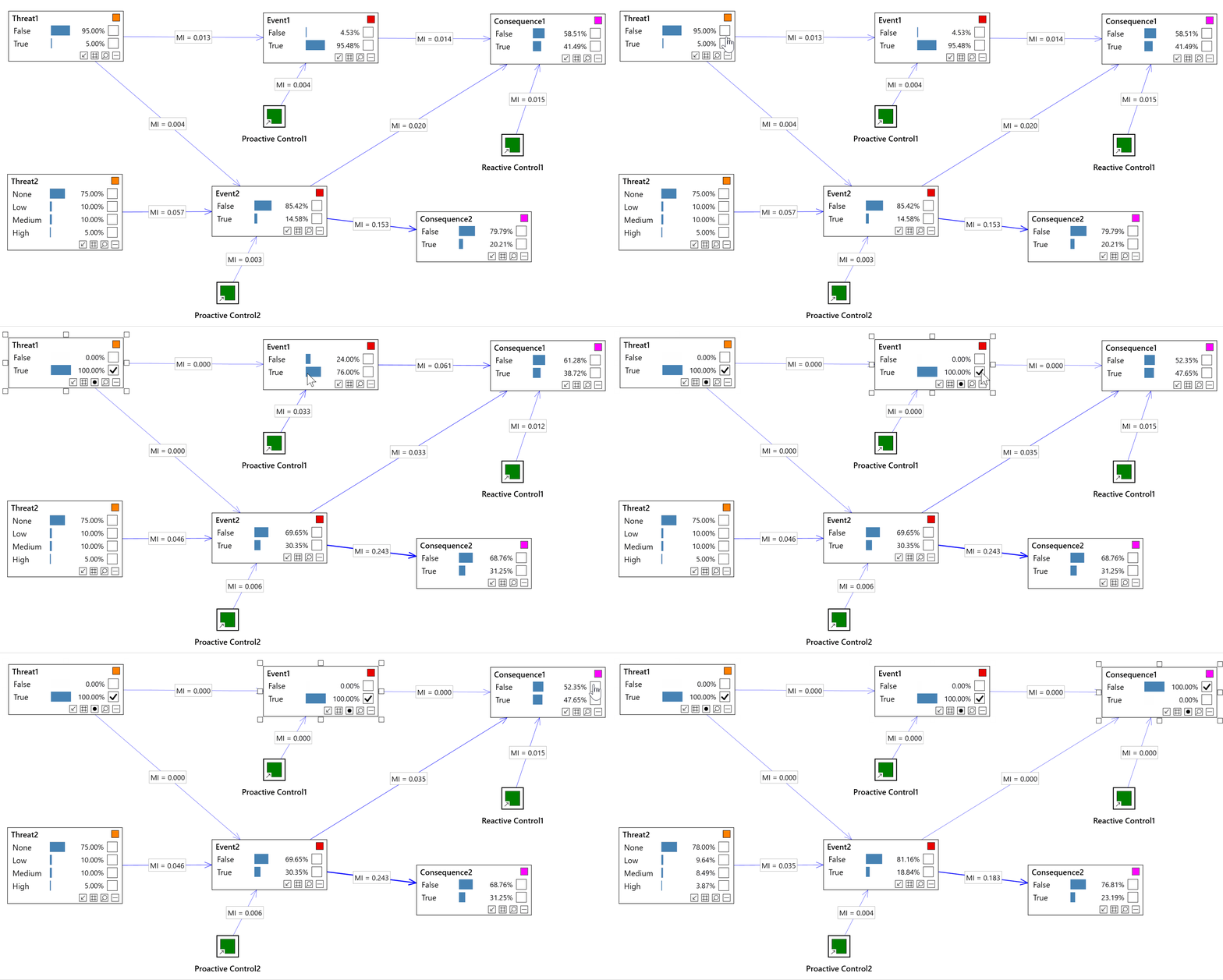 Source: Bayes Server Documentation – Risk Modeling